
11 QUESTIONS
with
STIJN ANK
1/11 Where do you go when you need to disappear?
To my work. It’s the only place for me, since childhood, where this disappearing (and appearing) is possible.
2/11 What deserves more attention?
The children, everywhere in the world.
3/11 Are you more drawn to beginnings or endings?
Beginnings. I like to get “drawn in” to something new. It’s a continuous desire.
4/11 What are you curious about right now?
My next trip to Istanbul and the Çanakkale Biennial. In Istanbul, I’m curious to experience the togetherness of the sculptures in the garden in Bebek, and for the Biennial, I’m thrilled to let a new work grow out of the landscape. All in the togetherness of my friends at Öktem Aykut.
5/11 Which color do you find yourself returning to?
White. For me, it feels like the origin, the source of space. In terms of light, it is the coming together of all colors.
6/11 Making or discovering?
Discovering. In this field, things make themselves and become living subjects.
7/11 What have you changed your mind about recently?
I just decided to sit in the sun instead of the shadow.
8/11 What is the oldest thing you own?
I guess it’s a fossil that we found in the Camargue, around 20 million years old. It’s embedded in limestone, which is a derivative of sea salt, and which is also the basis of the plaster I work with.
9/11 Which place has the best light?
From what I’ve witnessed so far, it was Mozia in Sicily and the Camargue in the south of France. A diffuse, white, salty light… where space turns into another dimension.
10/11 What do you always bring back from your travels?
Inspiration.
11/11 What gives you hope?
The children.
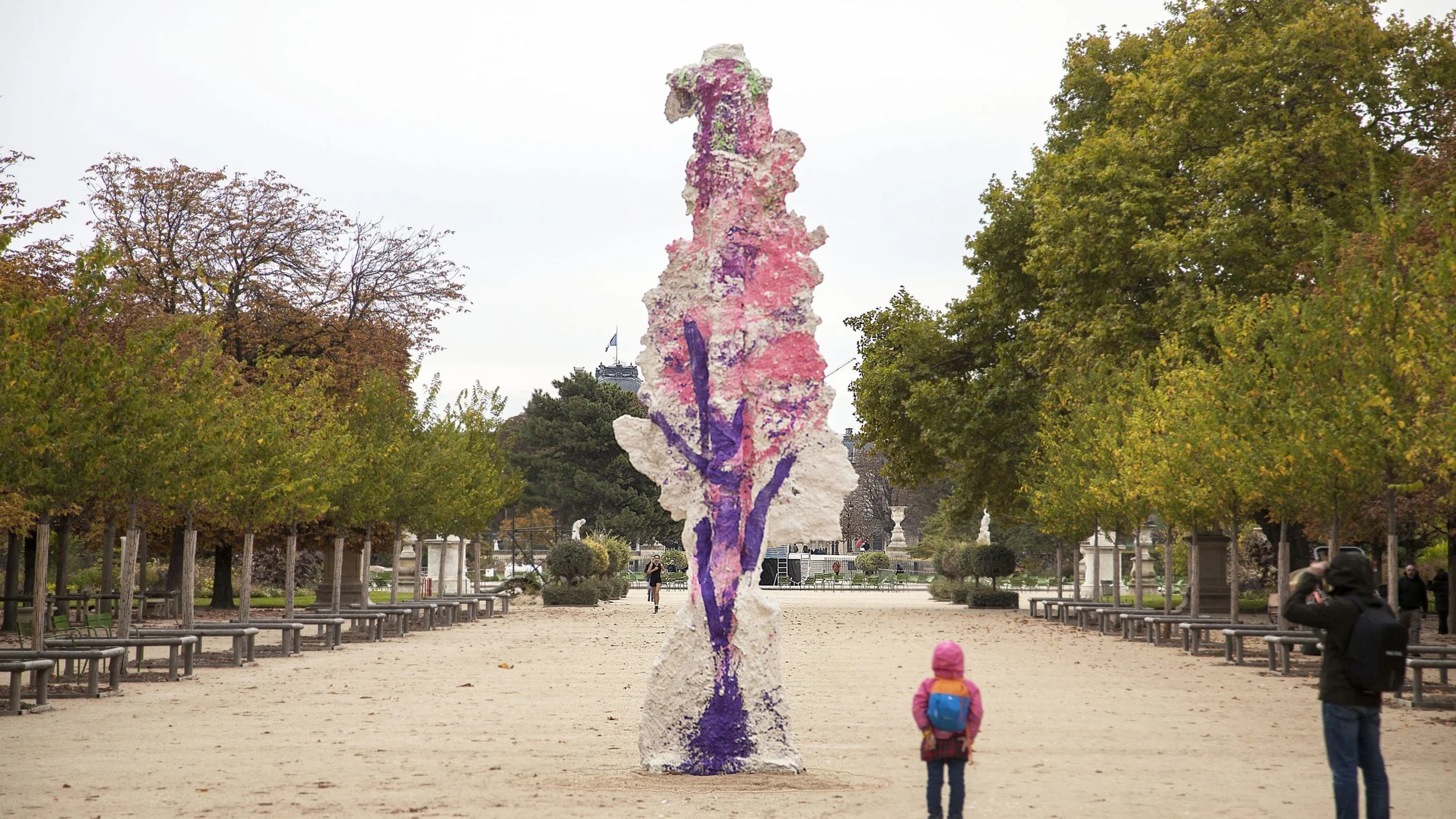
Phoenix 2022. Jardin des Tuileries – Louvre, Paris
Photo credit: Ian Swerts